A One-Minute Management Course From a Rancher

A One-Minute Management Course From a Rancher comes to us from a high school buddy of mine, Ryan Lum. (See my post on this blog on September 23, 2008 entitled, North Shore Cattle Company)

He’s now a rancher on the famed North Shore of Oahu, and sent this concise and practical email:

A  man is getting into the shower just as his wife is finishing up her shower, when the doorbell rings.

The wife quickly wraps herself in a towel and runs downstairs.  When she opens the door, there stands
Bob, the next-door  neighbor. Before she says a word, Bob says, “I’ll give you $800 to drop that
towel.”

After  thinking for a moment, the woman drops her towel and stands naked in front of Bob.

After a  few seconds, Bob hands her $800 and leaves. The woman wraps back up in the  towel and goes back upstairs.

When she gets to the bathroom, her husband asks, “Who was that?”

“It was Bob the next door neighbor,” she replies.

“Great!”,  the husband says, “did he say anything about the $800 he owes me?”

The Moral of the Story:

If you share critical information pertaining to credit and risk with your shareholders, in time, you may be in a position to prevent avoidable exposure.

Time is Money. Why Lose Either One?

When does -30 + 43 = 0?
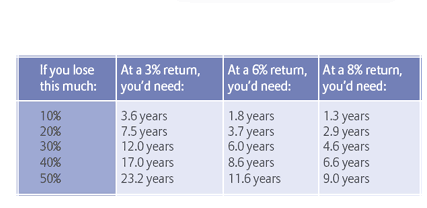
When it involves placing your hard earned retirement dollars directly into the stock market. If you LOST 30% this year, it would take a 43% GAIN next year just to get you back to where you started!

Recent headlines have been unnerving, to put it mildly. High-profile banks (Wachovia), brokerages (Lehman), and insurers (AIG) have been acquired, gone bankrupt or sought government loans. On September 29, when the U.S. Congress first rejected the Emergency Economic Stabilization Act of 2008, the U.S. stock market lost more than 8% of its value, its biggest one-day decline in more than two decades.

It’s no secret that playing the market has its risks, and losing money is only half the story. Have you ever thought about the time it would take for you to make up those losses? Here’s how long it would take to rebuild your nest egg after a loss in the market. (See chart below.)

Safe havens have been scarce. With the exception of U.S. Treasury securities–which one of our programs, the Flexible Dollar Builder is primarily invested into–just about all market segments have struggled. Also, as a hedge against downside risk, a fixed indexed annuity from Allianz can further help protect your portfolio. If the market drops in a year, your annuity’s value will remain constant. Later, if the market return is positive, your annuity’s value will increase-even if the market doesn’t make up its previous losses.

For example, let’s consider a modest, conservative example. A fixed index annuity with annual reset from Allianz with $100,000 in initial premium. (1) Let’s assume that the first year the market had a 32% loss. Had you invested your premium in the market, your portfolio would then be worth just $68,000. But with your fixed index annuity, you are protected from decreases in the market, and your annuity’s value remains at $100,000. (2) Now assume that in the second year, the market “bounced back” with a full 12% return. If you were invested in the market, your market value would still be much less than your original investment.

But in an Allianz fixed index annuity with a 7.5% cap, your original $100,000 annuity value would grow to $107,500 – worth almost $26,000 more than your money would be in the market. This hypothetical example is provided for illustrative purpose only. With the potential for downside risk protection, your annuity’s value increases or stays the same and never has to regain costly losses. Just imagine the potential for growth without the threat of decreases. Again, diversification.

Although an individual stock like Lehman Brothers can lose all its value, it’s highly unlikely that the value of all publicly traded U.S. businesses would go to zero. But as it has recently, the stock market can fluctuate dramatically. This market risk is the trade-off for the stock market’s potential to produce higher returns over time than those produced by less volatile assets.

As they have in crises past—the junk-bond meltdown in the early 1990s, the collapse of the tech-stock bubble in 2000—the time-tested principles of diversification and balance, fortified by a long-term perspective (you need to have time on your side), will most likely prove a productive response to the market’s turmoil.

Priority #1: Managing Yourself and Your Time

This month marks the seven-year point of my stint working with military personnel based here in Hawaii. I consider myself fortunate to play a small role in helping our fighting men and women of the U.S. Armed Forces achieve their financial goals. By doing what I do, they are given the peace of mind and the assurance that they can provide for their families on a long-term basis. For me this is why I do the thing I do.

There are great parallels between what we have created at SuccessHawaii and what I do at The Wheeler Group LLC through our association with the military. Like SuccessHawaii, our goal is simple–to help our clients reach theirs.

When meeting with prospective customers, I share with them the concept and idea that my mom, Dr. Linda Andrade Wheeler, passed on to me: If you don’t have a dream, you can’t make a dream come true. It all begins with goals. This is the beginning point. Without having a clear idea of what they want in life, the point of meeting with me is lost. They, like all of us, need a crystal clear vision of where they want to be financially in the future. Once we nail that down, we can move forward breaking their financial goals into manageable, realistic steps that will get them where they want to be.

“If you don’t have a dream, you can’t make a dream come true.”

In the past, Dr. Wheeler has given of herself and has conducted free seminars for the troops here in Hawaii. The emphasis of these classes is not simply money management, but rather a much more comprehensive approach to managing one’s life. It all starts with the notion of self-management. The core element in all of this is the empowering concept of developing a personal philosophy that makes you the owner of your own destiny, and not the victim of your circumstances.

In order to make this work, you need to develop a specific and practical plan of action for personal development. Your personal belief about yourself and what you deserve in life greatly impacts the actions you take in designing your destiny. In this day and age, it is all about balancing everything: mentally, emotionally, intellectually, physically and financially. In the Hawaiian language, there is a term that sums this up quite nicely. In essence the term, “Hookaulike”, means to bring into balance all the things to make you feel in harmony with the universe.

The second element she addresses in the seminar is the component of managing your time; ever critical in this fast-paced world we live in. A primary focus in this approach to time management is to plan your work; and work your plan. As she succinctly puts it,

“Goals without action is daydreaming; action without goals is spinning your wheels; but action with goals will get results.”

I don’t know about you, but I’ve daydreamed and spinned my wheels many times. I appreciate the simple and constant reminder that we all need to put goals on paper, and then figure out the best way to make them come true.
So what does it take to accomplish your goals and meet with the success you’re looking for?

Well, the next time I conduct seminars–for the 500th Military Intelligence division at Schofield Barracks (through Sgt. Major Marty Glenn) on October 17th, and in November for MSgt. Noel DeMello and his crew at the Hawaii Air National Guard–I will share that it takes desire, discipline and dedication. Like anything else, you don’t get anything for nothing. When it comes to wealth accumulation, you never get anywhere if you don’t have the savings habit. ‘Pay yourself first and what you don’t see, you won’t miss,’ is the old cliché, but altogether correct. But when you give something, you’re more likely to get something back. You’ve got to give to get what you desire. Like everything else in this world, it begins with you.

Currency Colloquialism: The Buck, Dough and Dollar

According to Chris Connell of the American Numismatic Association, we Americans have slinged around terms for money since the earliest days of our founding fathers. But what is the origins of this colloquialism, or informal words we use in conversation to describe the various denominations for currency in America?

Well, beginning in the 1740’s, for example, Americans were busy trading deer hides for goods and services, thus came the proverbial term for a dollar, a “Buck”.

Around 1767, a word derived from the Germanic “thaler,” was used throughout Europe and Great Britain from the 1500s to 1700s to refer to large silver coins. The English translation was “dollar.”

Another idiom used extensively to describe an insignificant value is the phrase, “not worth a red cent.” According to Stuart Berg Flexner (“Listening to America”), the original 1793 U.S. one-cent copper coin was issued until 1857. The cent has also been called ‘red cent,’ (from the copper’s reddish color). Since so many penny copper coins had been called ‘coppers,’ the first U.S. copper cent was immediately called a ‘copper’ and ‘copper cent.’ ‘Not worth a copper’ is an American term of 1788, followed years later by ‘not worth a red cent’.

Then, in 1851, “Dough” became widely accepted and was used extensively. It simply emphasized paper currency’s roles as one of life’s necessities.

Not long thereafter, Connell explains, the “Sawbuck,” was the norm when referring to a $10 bill. The name came from an early sawhorse whose crossed legs formed an X, the Roman numeral for 10, or a $10 bill.

On the website, Measuring Worth (http://www.measuringworth.com/index.html), there are numerous ways to measure relative worth. As the site points out, “if you are asking what a monetary value in the past is “worth” today, there is no one correct answer. A price or an income in the past would have been valued in different ways in that time by different people and under different contexts. That must be taken into account when asking the same question today”.

I myself have wondered how the very rich people of today compare to the Robber Barons of the past. Recently it was reported that Warren Buffet is the second richest person in the world and is worth some $50 billion today. When John D. Rockefeller died in 1937 he was worth $1.4 billion. Who, you ask, is richer in their time? The best way to analyze this question, according to Measuring Worth, is by questioning how big their wealth is compared to the economy they lived in during their time. This is measured by their share of GDP and for Rockefeller, that number is $210 billion, or four times greater than that of the ‘Oracle of Omaha’, Mr. Buffet.

Finally, the term, “grand,” when referring to money was first introduced into pop culture in the roaring 1920s. Today, we all know that a “grand” refers to a thousand dollars. But originally, when it first came on the scene, it was short for “grand amount,” which at the time was a whopping $1,000. Depending on what method we use to measure the value of a grand, or $1,000 in 1920, Measuring Worth pegs the value in 2008 at the definite “grand amount” of $156,000. Wow!

North Shore Cattle Company

View from the NSCC ranch, 1100 feet above Haleiwa, with Kaena Pt. in the distance.

My family and I had a wonderful time at the North Shore Cattle Company ranch yesterday. Check out their website for more details on this epic place.

My high school classmate, Ryan Lum, and his “ohana” run the working ranch that has stunning views of the famed North Shore of Oahu.

Way up, at over 1100 feet above Haleiwa, Ryan shared that the temperature has dropped way down to a chilly 45 degrees in the winter.

It was such a welcomed escape from the hustle and bustle of Honolulu.

And the bottomline: with restaurants like Alan Wong’s serving their premium, high-end, grass-fed-only beef, they are deservedly doing remarkably well. Congratulations to the Lums.

What an experience! Thanks, Ryan. Keep up the great work…

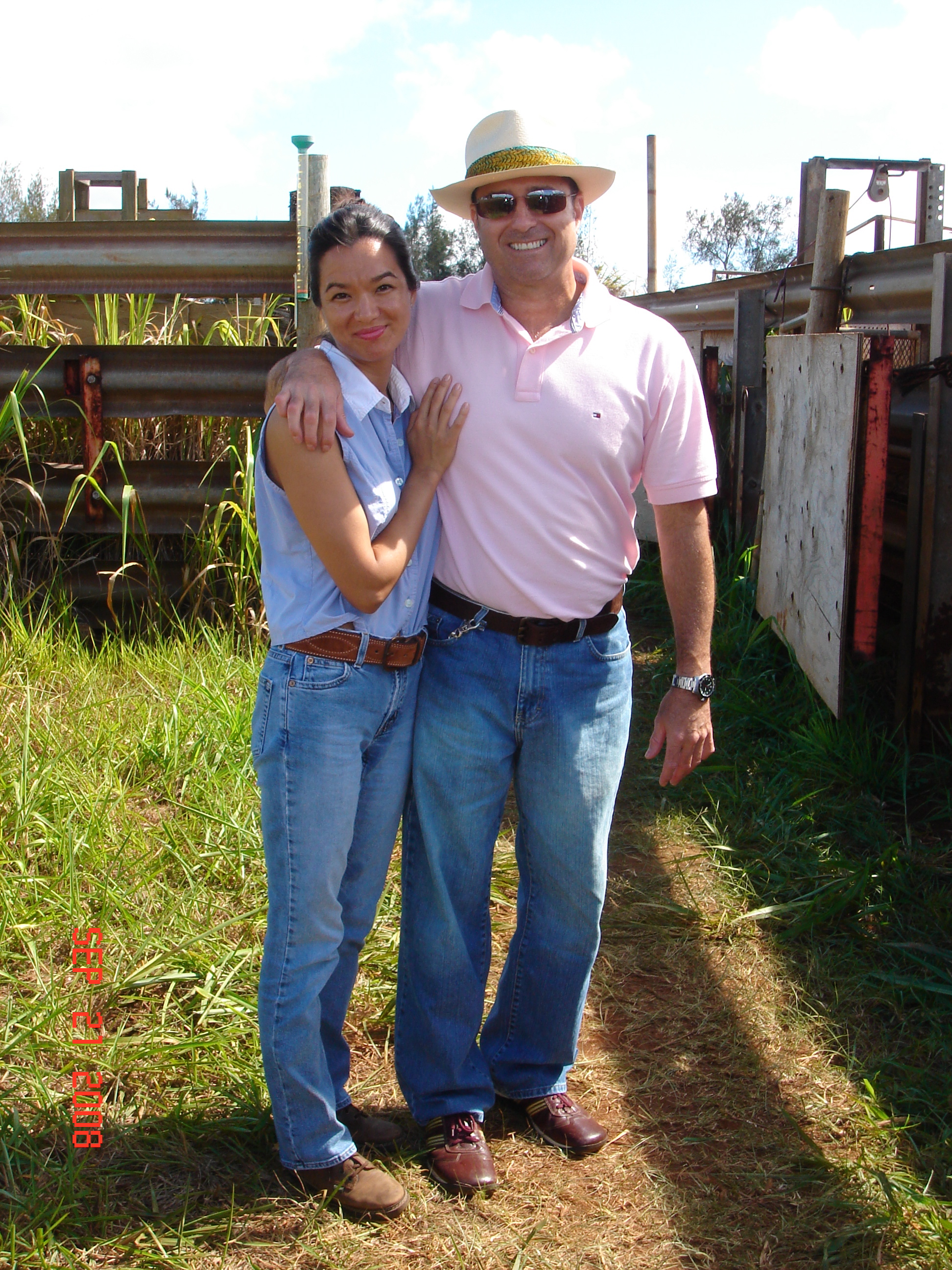
Me and my beautiful cowgirl, Michelle!

CARLIN ON AGING AND STAYING YOUNG

The following was an email I recently received from my mom, Dr. Linda Andrade Wheeler.

I love Carlin’s overall perspective/philosophy on life and his deep, comical intelligence.

Enjoy! Here it is:

Do you realize that the only time in our lives when we like to get old is when we’re kids? If you’re less than 10 years old, you’re so excited about aging that you think in fractions.

‘How old are you?’ ‘ I’m four and a half!’ You’re never thirty-six and a half. You’re four and a half, going on five! That’s the key.

You get into your teens, now they can’t hold you back. You jump to the next number, or even a few ahead.

‘How old are you?’ ‘I’m gonna be 16!’ You could be 13, but hey, you’re gonna be 16! And then the greatest day of your life! You become 21. Even the words sound like a ceremony. YOU BECOME 21. YESSSS!!!

But then you turn 30. Oooohh, what happened there? Makes you sound like bad milk! He TURNED; we had to throw him out. There’s no fun now, you’re just a sour-dumpling. What’s wrong? What’s changed?

You BECOME 21, you TURN 30, and then you’re PUSHING 40. Whoa! Put on the brakes, it’s all slipping away. Before you know it, you REACH 50 and your dreams are gone.

But wait!!! You MAKE it to 60. You didn’t think you would!

So you BECOME 21, TURN 30, PUSH 40, REACH 50 and MAKE it to 60.

You’ve built up so much speed that you HIT 70! After that it’s a day-by-day thing; you HIT Wednesday!

You get into your 80’s and every day is a complete cycle; you HIT lunch; you TURN 4:30; you REACH bedtime. And it doesn’t end there. Into the 90s, you start going backwards; ‘I Was JUST 92.’

Then a strange thing happens. If you make it over 100, you become a little kid again. ‘I’m 100 and a half!’
May you all make it to a healthy 100 and a half!!

HOW TO STAY YOUNG
1. Throw out nonessential numbers. This includes age, weight and height. Let the doctors worry about them. That is why you pay ‘them.’

2. Keep only cheerful friends. The grouches pull you down.

3. Keep learning. Learn more about the computer, crafts, gardening, whatever, even ham radio. Never let the brain idle. ‘An idle mind is the devil’s workshop.’ And the devil’s name is Alzheimer’s.

4. Enjoy the simple things.

5. Laugh often, long and loud. Laugh until you gasp for breath.
6. The tears happen. Endure, grieve, and move on. The only person, who is with us our entire life, is ourselves. Be ALIVE while you are alive.

7. Surround yourself with what you love, whether it’s family, pets, keepsakes, music, plants, hobbies, whatever. Your home is your refuge.

8. Cherish your health: If it is good, preserve it. If it is unstable, improve it. If it is beyond what you can improve, get help.

9. Don’t take guilt trips. Take a trip to the mall, even to the next county; to a foreign country but NOT to where the guilt is.

10. Tell the people you love that you love them, at every opportunity.

AND ALWAYS REMEMBER:
Life is not measured by the number of breaths we take, but by the moments that take our breath away. We all need to live life to its fullest each day!

Bugatti Veyron vs. Eurofighter Typhoon

The most technologically advanced car in the world, the Bugatti Veyron was pitted against the supersonic Eurofighter Typhoon jet plane in a head-to-head race of truly epic proportions. Which of these mechanical marvels will win? Well, the Bugatti is quite impressive. It can hit 253 mph and is heralded as the quickest accelerating and decelerating street-legal production car in the world. But compared to the jet, which tops out at 1500 mph, it’s a snail. So the race is pretty straightforward, right? Not so. Here’s the twist, the jet will need to shoot up a mile into the sky and come back down; while the supercar will need to go one mile down the runway and make it back; both covering two miles. The first back to the starting line, wins the race. See the mind-boggling race for yourself– Bugatti Veyron vs Eurofighter Typhoon Jet.

Unbelievable, but I saw it for myself; it’s the real thing. Top Gear BBC featured this in their popular auto show on TV recently. Of course, it’s a novelty of sorts, but it’s still cool. The Bugatti Veyron racing a Eurofighter Typhoon Jet over a 2 mile tarmac turned “drag strip”. Click here to see the race.

I can still remember walking into the Ettore Bugatti store in Waikiki over a decade ago. It was a big event for Honolulu when it premiered. Even the Robb Report interviewed Crazy Shirts founder, Rick Ralston, who brought it to Hawaii. But only two months after that interview appeared in the magazine, Ralston shut the store down. We have many high-end boutiques on Kalakaua Avenue, but this store’s quality was a cut above, and the prices were too. I went to the closing/liquidation sale, and the stuff was still just way too expensive.

Consider the Veyron supercar: At $1.7 million, it’s the most expensive production car in the world. The way I see it, if you’re fortunate enough to afford one, you are getting a ridiculously special vehicle. They truly take their time in putting together this automotive masterpiece. It is said that only two are completed weekly. When I read that statistic, my knee jerk reaction was, “that many?”

What makes any car worth the price of a (small) beachfront home? Well, overpriced parts, for one. To give you an example, the square-head bolts that hold together the air ducts on this supercar are made from titanium, and costs more than $100 apiece. Although most of us can’t, if you can afford it, and it would just represent a little splurging, then go ahead and make yourself happy. It might just be good for your health.

Hard to believe, but on July 7, 2008, the Wall Street Journal featured an article entitled, “Splurging Is Good for Your Health”. Appearing in the Harvard Business Review, researchers came up with the virtues and regrets of consumers. As the WSJ put it, “Whether luxury is good for your finances is another matter.” All I do know for certain is that spending more than you make is not good for your financial health.

Whatever the case, enjoy the race!

Our Bodies: There is no better return on your investment

My fiancé, Michelle and I, recently took in that much publicized and controversial exhibit called, Bodies The Exhibition. Showcasing the human body with actual, real human specimens, some detractors have accused it of being pure sensationalism, questioning the origins of the cadavers.

Personally I came away with a better understanding of the internal mapping of my own imperfect body. Seeing it full-size is very different than an illustration in an anatomy book. Ultimately, I choose not to get caught up in the activism of it all. Rather, as an organ donor myself, I believe in it’s educational value and the science of it all.

To see it—the human body—is its full glory (yep, full glory) is definitely eye-opening and fascinating. The method by which they have preserved these actual human bodies is simply incredible and it gave us a chance to literally peer into ourselves.

Apparently, the technology of using silicone polymers has been around since the 1970s. I learned that it uses a process called, Plastination. However, the controversial nature of the exhibit itself has precluded its acceptance in the mainstream until only recently.

Bodies’ Education Director Cheryl Mure said, “You have one body from the day you are born till you take your last breath, and we want you to come here and be inspired to take better care of it.” It did that for me and I totally agree with Mure.

In a CNN/Money article, they posed the question, “What’s the connection between physical and financial well-being?” Well, according to the article, “For sheer impact on your bottom line, experts say nothing beats taking care of yourself.” On personal note, having survived breaking my neck three years ago, I totally concur with their message that “it’s time to invest in your biggest asset: You.”

There is no better return on your investment.

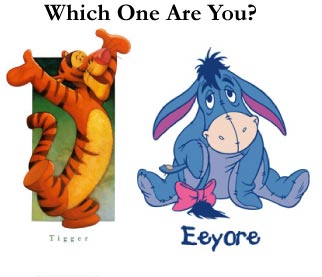
Are You a Tigger or an Eeyore?

Last Friday, July 25, 2008, Diane Sawyer announced on Good Morning America that Randy Pausch had passed away. Who was Pausch? Well, for one he was a Professor of Computer Science at Carnegie Mellon University (CMU) in Pittsburgh, Pennsylvania, as well as a best-selling author. But most notably, he achieved worldwide fame for his “The Last Lecture” speech on September 18, 2007.


It all began with one, age-old question: What would you say if you knew you were going to die and had a chance to sum up everything that was most important to you? For Pausch though, the question was too real. Pausch, a father of three small children with his wife Jai, had been diagnosed with pancreatic cancer—and given six months to live. But instead of focusing on his death, Pausch spoke about his childhood dreams. He went on to attain almost all of those dreams, but they didn’t all come easy.

In the lecture, he spoke of overcoming the obstacles that may seem insurmountable. One of the reasons Pausch was so highly thought of by his students was his extraordinary way of looking at obstacles: “The brick walls are there for a reason,” he said during his last lecture. “The brick walls are not there to keep us out. The brick walls are there to give us a chance to show how badly we want something.” In essence, he was telling his students, ‘it was there to keep others out, not us’.

Continue reading