A Really Simple, Guaranteed Formula for Success

Quality guru and bestselling management author (“In Search of Excellence”), Tom Peters, recounts the story of a man who approached robber baron and American financer  J. P. Morgan with an envelope, and said:

“Sir, in my hand I hold a guaranteed formula for success, which I will gladly sell you for $25,000.”

“Sir,” J. Pierrepont replied, “I do not know what is in the envelope. However, if you show me, and I like it, I give you my word as a gentleman that I will pay you what you ask.” The man agreed to the terms, and handed over the envelope. Morgan opened it, and pulled out a single sheet of paper. He gave it one look – a mere glance – then handed it back to the gentleman. And then he paid him the agreed-upon amount of $25,000! On that sheet of paper, were two things:

1. Every morning, write down a list of the things that need to be done that day.
2. Do them.

Clearly J.P. Morgan benefited handsomely from this advice. The point of this anecdote is that you can too. Oftentimes, we ourselves know what we must do. Yet, just simply knowing what needs to get done is the easy part. If you’re like me, you have your list of things to do. It represents our action items, plans and declarations. But taking action is the tough stuff. When you think about it, that’s the trademark of every successful person.

“If you want something done, ask a busy person to do it.”

-Lucille Ball

We all know that it’s easier said than done. Ultimately, we have to just do it and taking baby steps daily is a great start.

The difference between a successful person and others is not a lack of strength, not a lack of knowledge, but rather a lack in will.
Vince Lombardi

In his book, “The Common Denominator of Success”, Albert Gray says, “The common denominator of success–the secret of success of every man who has ever been successful–lies in the fact that he formed the habit of doing things that failures don’t like to do.”

As the $25,000 solution illustrates, one needs to keep it simple, but taking action and “doing things that failures don’t like to do” is the trait successful people share.

A journey of a thousand miles begins with a single step.
Lao-tzu, The Way of Lao-tzu
Chinese philosopher (604 BC – 531 BC)

Life Lessons from the “Wizard of Westwood”

“Success is a peace of mind which is a direct result of self-satisfaction in knowing you did your best to become the best that you are capable of becoming.” –Coach John Wooden

I vividly recall my mom, Dr. Linda Andrade Wheeler, preparing for one of the many corporate training seminars she did when we partnered in business together at The Human Connection, Inc. It was in the early 90’s and one of the handouts to be shared with seminar participants was legendary Coach John Wooden’s, “Pyramid of Success” motivational program (a faded copy still remains in my research file, but here’s a new, printable PDF). Wooden tied success not to achievement, wealth or fame, but to how close a person came to their potential.

In essence, the Pyramid of Success consists of philosophical building blocks for winning at basketball and at life. According to John Wooden’s Pyramid of Success, there are 12 lessons in leadership. At the summit of the pyramid is “success”. Each of the blocks represents a trait that a person must possess in order to become successful in life just like in playing a basketball game. At the time, as a recent Bruin graduate (1989), I was both intrigued and proud to be remotely associated–however indirectly–with such a legendary motivator and strong Christian. During his long tenure with the Bruins, Coach Wooden became affectionately known as the “Wizard of Westwood. Continue reading

SELF-MANAGEMENT: KEY TO MASTERING CHANGE

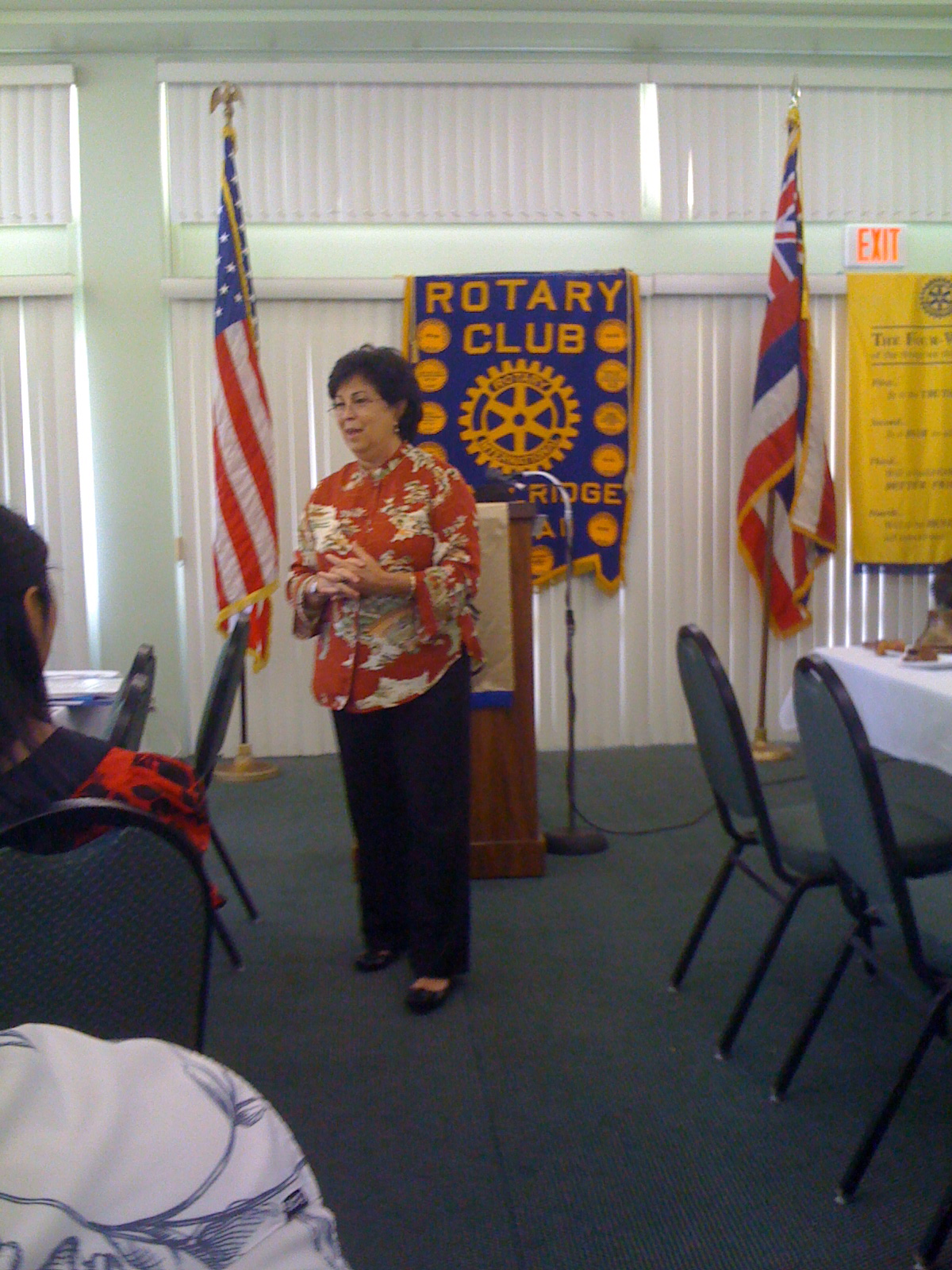
LW1In her presentation last Friday, Dr. Linda Andrade Wheeler shared methods with the members of the Pearlridge Rotary Club by which they could better gear up for meeting the varied volume of changes that occur in their personal and professional lives. She emphasized that the uniqueness of each individual is his or her competitive edge and paramount to achieving “personal excellence”.

As she put it, “You are better at being yourself than anyone else”. Her primary message was really to convey the notion that how well people use their personal power, determines in large part their level of personal excellence, the quality of their relationships and eventually their lifestyle.

Two books from her repertoire were referenced in her talk and are available at http://drlindawheeler.com/:

1. Ain’t Life an Artichoke: It Takes a Lot of Peeling to Get to the Heart…The Best Part This book is about personal excellence–the process of self-discovery and a journey to your heart, which you must take alone to find your uniqueness. The process can be uplifting and bring a brand new perspective to your life.

2. The Power of Resiliency Bouncing Back in a Changing World “Resiliency”—is about being happy in spite of change—or maybe as the result of it. It’s about growing through life’s changes and bouncing back in spite of adverse situations.

For more information on Dr. Wheeler’s seminars and books, please check out http://drlindawheeler.com/

“What is Your Greatest Asset?”

Without hesitation, many people believe that their greatest asset is their home, or their retirement savings. Neither is correct. To be clear, your greatest asset is your ability to earn an income, that is, to make money and bring home a paycheck.

In a nutshell, my job is to help my clients protect their paycheck. My role is to solve a problem, and in this case, risk is their problem. We facilitate the transfer of risk. As I tell my valued clients, “let’s face it, your greatest asset desperately needs to be protected…” It is the foundation on which all of their hopes, dreams and aspirations are built. Without this type of “paycheck protection” coverage, it leaves them vulnerable financially. Continue reading

Top 10 Reasons to Buy a Long Term Care (LTC) Insurance Policy

Perhaps Dorothy, in “The Wizards of Oz”, said it best: There’s no place like home! That’s why many Hawaii residents who need LTC prefer to receive it in their own homes. The ability to live independently is critical to maintaining quality of life. Remember, long-term care is not just about nursing homes anymore. Ultimately, coverage gives you the freedom of choice.

Here are my top ten reasons to buy LTC insurance coverage:

1. You will have an experienced professional available to plan for your care at home, providing all types of services related to your particular illness, injury, or condition.

2. Your family can be part of the care plan, but will not have to be the planners.

3. You will have the money to pay for long term care (according to PBN, Hawaii ranked 7th most expensive in the nation for home care services, with a median annual rate of $51,480 in 2010) without having to deplete the family nest egg.

4. Your loved ones can carry on a more normal life rather than being subject to your everyday (“activities of daily living” like bathing, dressing, eating, toileting, etc.) needs.

5. Your family will be able to attend to your needs out of love rather than obligation.

6. Because you’ll have the funds, you will be able to choose your own facility or choose to stay at home longer rather than prematurely entering a nursing home.

7. You will be able to leave some of what you have to your family rather than using up a large portion of their assets to pay for needed care.

8. You will be able to stay with your children or other loved ones without depending on them for all your care.

9. You can feel good knowing that all of the money you worked so hard to attain won’t be used up in a few short years (PBN reported that Hawaii’s nursing home costs have a median annual rate of $114,975, compared to the national average of $75,190).

10. Finally, there will be less friction between family members; one member won’t be stuck with the responsibility of caregiving.

M. Garrett Wheeler is a long-term care specialist with Guardian in Honolulu, Hawaii. He’ll be glad to explore your options for coverage that suits you best, so that if you ever need it, you’ll have the freedom to choose the care setting that is most appropriate for your circumstances. He may be reached at gage@successhawaii.com or by phone at (808) 216-4147.

Is Your Paycheck Protected?

While most people don’t think twice about insuring their cars and homes, they often leave one of their most important assets unprotected—their paychecks. Working Americans rely heavily on their paychecks to support their families and to fund their everyday living expenses, but few consider how their lives would be affected if they were unable to work due to an illness or injury and couldn’t bring home a paycheck. Ask yourself: Could you afford to live without your income?

“Your paycheck is clearly one of your most valuable assets. Just as you insure other valuables in your life, such as your home or car, it is crucial to insure your income,” says Garrett Wheeler, a disability insurance (DI) expert with Guardian in Honolulu, Hawaii. “Think of disability insurance as insurance for your paycheck. It provides an income if you’re unable to work due to an illness or injury.” According to the LIFE Foundation survey, nearly 50 percent of working Americans say they would not be able to make it a month before financial difficulties would set if a disability were to keep them out of work. More than one in four say they would face financial problems immediately. Continue reading

It’s Your Retirement Dollars: A Wharton Professor on FIAs

I have a client approaching retirement age and it prompted me to complete some due diligence on a financial product he expressed some interest in learning more about on a practical level. As I shared with him, ever since I first learned of Fixed (or Equity) Indexed Annuities (FIAs) about seven years ago, I have been perplexed by what I have read. Technically, I understand this complex financial instrument. But the esoteric and intangibles from the press is elusive, at best. There have been some good things pointed out, but mostly it has been bad, negative press.

I understand their position: There were those unscrupulous agents in the financial services industry who took advantage of the elderly and it further served to fuel the flame of negativity. It became headline news when Chris Hansen, the Dateline Correspondent famous for his, “To Catch a Predator” series, “began hearing complaints from senior citizens and government regulators across the country about the tactics some insurance salesmen are using to sell certain investments to retired folks.” Ultimately I agree with Hansen when he said, “it may be appropriate for some, but not for everyone.” I couldn’t agree more. For the right person, it is a strong and viable financial product; for others’ it is inappropriate. But to blame the actual product and label FIAs so negatively, when it is not, is equally misleading. Again, I believe it all boils down to appropriateness. However, what the mainstream press has conveyed to the general public is one-sided. All that seems to have been written about FIAs is skewed to demonize it as a ripoff and financial hoax, when it clearly is not.

I was pleased to come across the following interview by such a highly regarded Wharton School of Business Professor, Dr. David Babbel. As far as I am aware, this is the only study that exists that is wholly objective and totally based on solid academic research by a person with absolutely no monetary, or regulatory influence to gain. He’s credible: He’s from Wharton, not some unknown, online-only university. Needless to say, I was ecstatic and felt vindicated in my beliefs. The way I see it, it’s your retirement dollars at stake, educate yourself. Start by listening to the following interview below, or at bare minimum, read the transcript of the interview as the information could make a huge difference in how you allocate your retirement funds and it’s distribution successfully. Here’s to your financial success!

Annuity Digest Radio Interview

Annuity Digest Radio Transcript (PDF)

The Five “Wheeler Points”…by Elmer Wheeler

Click Here to view a short video by Elmer Wheeler. The YouTube video of Elmer Wheeler is of him presenting his 5 'Wheeler' points on how to increase your sales and profits. What an era this was and a classic it produced...to your success!

First of all, in the spirit of disclosure and to be clear, Elmer Wheeler and I are unrelated, irrespective of our last names. Nevertheless, his ideas are as applicable today as when he wrote them more than 70 years ago.

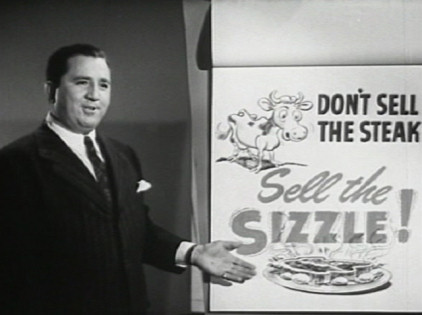
“Sell the Steak, not the Sizzle!”

You won’t find this long-lost marketing classic at your neighborhood bookstore, they’re out of print and rare to find–anywhere! But you certainly CAN find it here! See below for a sneak peek at the first chapter of this book. Order by clicking here: “Tested Sentences that Sell”

In his book, “Tested Sentences that Sell”, Wheeler summarizes the findings from his “Wheeler Word Laboratory”–measuring the effectiveness of certain words and using them strategically to boost sales results. Among the most notable is Wheelerpoint#1, “Sell the Steak, not the Sizzle!”–the biggest selling point in your entire sales proposition.

In the video below, Wheeler summarizes his 5 Wheeler Points.

Also, after checking out this old training video, click ElmerWheeler.Book and attached you will find a snippet of Tested Sentences that Sell–the first chapter from his book for your review in pdf format. If you feel like I did, that this book should be a part of your library, then click here to get it now! “Tested Sentences that Sell”

Here’s to your success!

M. Garrett Wheeler

How Guardian Calculates Individual Life Dividends

I received a memo from Jess Geller, Vice President & Actuary at The Guardian Life Insurance Company of America (Guardian), New York, NY. The memorandum explained key terms, described the calculation of policy dividends, and provided a sample dividend calculation. While it may be tedious and mind-numbing, as with much of “actuarial” topics (for me, anyway), I am sharing this technical and informational post with clients who have an analytical bent. Here it is.

Contribution Principle: Guardian allocates the dividend fund to policies in accordance with the contribution principle. This principle is designed to allocate dividends to each participating policy in the proportion that the policy contributed to Company earnings. This principle is the accepted standard of practice for mutual insurance companies in the United States. Guardian is a well-diversified company. Profits from other lines of business play an important role in determining dividends that are passed through to policyowners.

Continue reading