
From $2 Bills to $100 Billion Bank Notes

Can you imagine? A $100,000,000,000 bill. You heard right…

In a previous post, I wrote about my personal experiences with our $2 bill. At the moment, the U.S. economy is slowly moving toward a recession, and economic pressure is everywhere. We all certainly feel it at the gas pump, and in the grocery stores. However, what is occurring economically in Zimbabwe should put things in perspective for all of us Americans.

With the official Zimbabwe inflation rate now at 2.2 million percent, the once-prosperous Zimbabwe has seen an unprecedented economic meltdown since it gained independence in 1980. According to the New York Times, in January 2008, “the government of President Robert G. Mugabe, battered by hyperinflation, said it would begin issuing new currency beginning Friday: $1 million, $5 million and $10 million notes.”

Z100bn_noteA $10 million note.

Newsweek ran an article earlier in 2008 entitled: ‘Poor Billionaires’. The sub-heading read, “In a nation with rampant hyperinflation, bread is a bargain at just $10 million.” The article went on to explain, “The bill, released for the first time last month, is actually not a proper currency note at all but rather a “bearer check.” Zimbabwe stopped printing real money long ago, when its inflation rate was still at a manageable level. Today these bearer checks are the only currency remaining. Last week in Zimbabwe 10 million dollars could buy exactly two rolls of toilet paper.” Terribly, only several months would go by and things would get exponentially worse.

Now (July 19, 2008) CNN has released an update: “Zimbabwe’s troubled central bank introduced $100 billion banknotes Saturday in a desperate bid to ease the recurrent cash shortages plaguing the inflation-ravaged economy.

A shopper displays a $500 million Zimbabwean bank note.

A shopper displays a $500 million Zimbabwean bank note.

The bills officially come into circulation Monday, although they were on the foreign currency dealers market Saturday. As high as they are, though, the bills still aren’t enough to buy a loaf of bread. They can buy only four oranges.”

After doing some research for this post, back here in America, what seems to me as outrageously high gasoline and food prices is now more palatable, yet still unacceptable, but ultimately, not stinging as badly. Of course, still these crazy prices has driven inflation (5.3% in June) to the biggest annual jump since 1991 (in Hawaii, we vividly remember the impact the Gulf War had on our island economy). A separate Labor Department report showed the average hourly wage up only 3.4% over the same 12-month period, meaning the typical American is having trouble keeping up with the price increases.

One measure of the economic stress on households is the so-called economic misery index which is calculated by adding the 12-month inflation rate and the unemployment rate. With the jump in inflation to over 5% in June from 4.2% in May 2008, the misery index is now at 10.5, the first time it has hit double digits since 1993.

Ain’t Life An Artichoke?

“A goal without action is a dream;

all action without a goal is passing time;

and a goal with action is accomplishment.”

From the #1 Bestselling Book by Dr. Linda Andrade Wheeler. (Yep, you got that right: Not self-promotion; but shameless family promotion. If you know something is good, share it. That’s what I’m doing here with you. Dr. Wheeler is my mom and I’m truly proud of her accomplishments…find out for yourself why her books are perennial Hawaii bestsellers. The book is on its third printing.)

Ain’t Life an Artichoke: It Takes a Lot of Peeling to Get to the Heart…The Best Part

This book is about personal excellence–the process of self-discovery and self-renewal as you interact with others in building healthy & happy relationships. It is about a journey to your heart, which you must take alone to find your uniqueness. The process can be uplifting and bring a brand new perspective to your life.

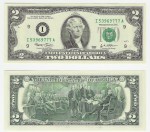
Saving Money $2 At a Time

I still remember receiving $2 bills for my birthday every year. As if a family tradition, my grandparents (who lived in the Sierra Nevada mountains of California) sent them to me in Hawaii every year without fail. There was never a surprise, just a $2 bill in the letter. Without missing the message, my parents always made us call them to express our appreciation.

At the time, I used to think they were a bit tight. Later I would learn that when they passed on, they had amassed over $125,000 (in the 1980’s) in bank savings! I was proud of them and understood why they did what they did.

They knew something about saving money. Maybe there hope was that I would choose to save the $2 bills as keepsakes—I still have them 30 years later—and not spend them. (Later I would learn the importance of, “compound interest”.) According to the United States Department of the Treasury, it seems to be what most people do with them.

In spite of its relatively low value among the denominations of U.S. currency, the two-dollar bill is one of the most rarely seen in circulation and actual use. They are almost never given as change for commercial transactions, and thus consumers rarely have them on hand. After 13 years in business as a day-to-day retailer at Successories of Hawaii, I can’t remember accepting a $2 bill as form of customer payment. Production of the note is quite low; approximately 1% of all notes currently produced are $2 bills.

The $2 bill has not been removed from circulation and is still a circulating denomination of United States paper currency. The Federal Reserve System does not, however, request the printing of that denomination as often as the others. As of April 30, 2007 there were $1,549,052,714 worth of $2 bills in circulation worldwide.

In one of her catch phrases, gold-hued financial planning guru, Suze Orman, put it in perspective well, “People first, then money, then things”. My grandmother had her own way of summing the same up. In every letter she wrote, she signed-off, “Remember you are loved”. I agree that we all need to know that we are loved. But at eleven years old, I assumed that. I just wanted a $20, not a $2 bill. Thanks, grandma.

United States

Department of the Treasury

http://www.ustreas.gov/education/faq/currency/denominations.shtml