
Category: Stocks
How to SEA (Strategically Engage and Adapt) to Manage Market Volatility
The trader’s saying, “The stock market takes the stairs up and the elevator down,” perfectly captures how swiftly stock prices can change—something we’ve witnessed quite clearly in recent days.
Here’s how the recent stock market drop unfolded: First, disappointing Q2 corporate reports from several high-profile tech companies set the stage, compounded by Federal Chair Powell’s discouraging comments about short-term interest rates. This was followed by confusion in the Japanese market and other international issues, all mixed with uncertainty surrounding the upcoming election. In an instant, stock prices pulled back.
However, it’s important to remember that volatility is a natural part of the investing process. Historically, investors have experienced pullbacks of 3 percent more than seven times a year, and since 1928, a 10 percent correction has occurred at least once annually. When seen through this historical lens, recent market fluctuations aren’t as unusual as they might initially appear.
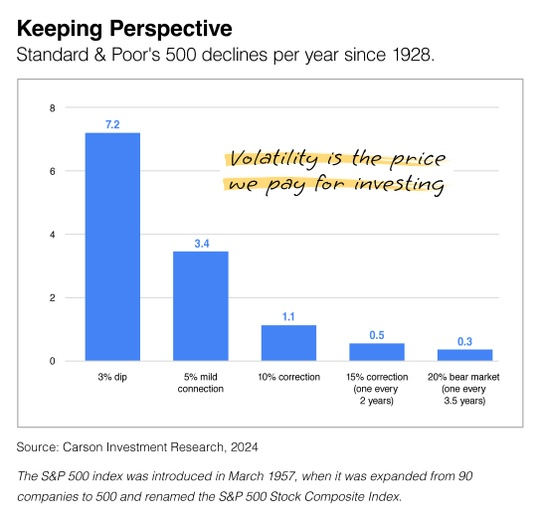
I understand that it can be unsettling when stock prices pull back or enter correction territory. The financial media often amplifies the day’s events, making them seem overwhelming and causing some investors to lose sight of their long-term strategy.
If you’re beginning to feel like “it’s different this time,” please reach out to me as soon as possible. I’d like to hear your perspective and work together to help us find a more comfortable position moving forward. -GW

Key Points to Help you Feel more at Ease with this Nutty Volatility
Epic volatility is the norm? Check out this list from the LPL group. First point they make: This. Is. Normal. I love it. Good stuff. The message is this: Hang in there, you’ll be rewarded. And finally, to make you feel better, you’re not alone…
LPL’s article started off with a reassuring message in these times of nutty volatility. It said, “Although market uncertainty might make you feel jittery, keeping your investment cool is critical to your financial success.” I totally agree. No doubt, it’s difficult watching your cherished portfolio bob up and down. Before you drive yourself batty, consider these six things before, as LPL puts it, “acting out of emotion”:
1. Again, remember “This. Is. Normal.”
It goes with the territory and that is, ‘volatility is part of investing’. Yep, when stock prices steadily rise with little movement, it’s easier said than done, but don’t forget the fact that volatility is incredibly common. It’s the norm, not the exception.
The past teaches. Always remember what happened in the past. If you’re old enough, you’ll recall the early 2000’s ‘tech bust’, then again in 2008 with the big boom. It happens. That’s why they call it, ‘cyclical’. The market dips like clockwork almost annually. Don’t fret, and especially don’t freaking panic. Because, let’s face it, the ‘best part may be what happens after these dips’, says LPL. I agree.
Get this, research show that after a correction, the average returns exceed 23% over the next 12 months.1 Nice!
2. Patience, my friend. You’ll be (typically) rewarded.
LPL did a good job with their research. LPL states, “Investing in the stock market gives you a chance to profit from innovation, economic progress, and compound growth. But to get results, you need patience and time.” LPL went on to say, “On this note, it’s helpful to keep the market’s performance history top-of-mind:
Since 1990, the Dow Jones Industrial Average has achieved 9.5% annualized gains, including dividends. Even if you were to look at shorter time horizons since 1950, the S&P 500 has risen 83% of the time across a five-year horizon, 92% across 10-year periods, and 100% of all rolling 15-year periods.2
And while history can’t predict future performance, it can give you an idea of what could happen if you try to take a shortcut or “panic sell” when markets are fluctuating:
From 1990 to 2020, the S&P 500 Index’s annualized gain was 7.5% (excluding dividends), but the average equity investor’s return was only 2.9%.3 Why the 4.6% gap? Because when stock prices begin to fall, many investors given in to fear, which drives them to sell their investments – even though it may not be in their best interest.”
My fav investor, like millions of others’ is the ‘oracle of Omaha’, Warren Buffet. He once famously said, investing in the stock market is “a way for the impatient to transfer money to the patient.”4
3. Market timing doesn’t work
We’ve heard it over and over. But clients keep trying to outsmart the smart guys who do this for a living. Analysts and CFA’s keep telling us not to time the market, it could be a costly mistake. Do people listen? Of course, not. We’re human.
LPL says, “It’s impossible to predict when a stock or the market as a whole will peak or bottom, even if you’re an expert. In a market decline, if you sell in fear of losing more, you’ll then have to figure out when to jump back in, which is equally difficult. Plus you risk locking in your losses if you re-enter at the wrong time. For example, between 1990 and 2020, the biggest gains (and losses) in the market happened within days of each other, which means you didn’t have to be out of the market for long to miss out on the upswing.2 Because even in “bad” markets, there are a lot of good days, and you want to be “in” for those days.”
4. No Sweat, Opportunities abound
The creative analyticals tend to win at this game of looking at volatility from both buying and selling angles. LPL reminds us, “When stocks decline, you can “buy in” at a lower price and potentially make money when the market rights itself. When the decline is part of an overall cycle, this means stocks are trading below their intrinsic values, which means they offer an improved price-to-earnings ratio.”
5. LPL says, “There are ways to enjoy a smoother experience“
Good ‘ol dollar-cost averaging(DCA). It’s simple and basic, but it works. DCA can help reduce the overall impact of price volatility and lower the cost per share of your investments. Forget about timing the market; trying to get in and out at the “right” time. Instead, dollar cost averaging can be a better strategy to help you avoid timing mistakes. Ultimately, it removes the dreaded, ’emotion’ from your decision-making process. DCA can help keep your long-term goals in mind.5
6. We’re all in it together. You’re not alone
As a final reminder, LPL tells us that, ‘in times of market volatility and economic uncertainty, remember that you’re not alone.’ Good advice for the wary. The best advice LPL had in their entire article was this: Consult your financial advisor for additional perspective and context, and review your investment strategy from a life-goals perspective to ensure you’re headed in the right direction to pursue your financial goals. As a fiduciary financial advisor, I commend LPL’s wisdom. Smart guys.
1 Source: LPL Research, Ned Davis Research, FactSet 4/29/22
2 Source: LPL Research, FactSet 4/29/22
3 Source: LPL Research, Bloomberg, DALBAR, ClearBridge Investments 6/30/21
4 Source: “Winning In The Market With The Patience Of The Wright Brothers And Warren Buffett,” Forbes, (January 2018).
5 Source: https://www.forbes.com/advisor/investing/dollar-cost-averaging/
This material was prepared by LPL Financial, LLC.
FANG Stock: Be Diligent
 Out of curiosity I just Googled, “FANG Stock”. Here’s what I got: Diamondback Energy Inc. NASDAQ: FANG – Sep 6, 4:40 PM EDT. That is not what I was looking for. What I was actually in search of was more details on FANG, the acronym for Facebook Inc., Amazon.com, Inc., Netflix, Inc. and Google (which is now Alphabet Inc.). Because these are top-performing technology stocks, they get a disproportionately large amount of the headlines when it comes to stocks. And that’s for good reason, what they have created is smack-dab-in-the-middle of pop culture. All four companies are disrupters. You could say they run our tech world. Of course there are other major players that I like (i.e. Cisco, etc.). But with my brother, Milton, introducing me to “Narcos,” on Netflix, FANG has been on my mind. That doesn’t mean you should go out and mortgage the house (or short the farm), but to me it’s worthwhile to look at, if you have an interest. And I’m curious.
The companies that make up FANG are popular for good reason. But what does analytics tell us about their past performance? Are they worthwhile investments? You bet they are and have been. Google it. How about moving forward? Your guess is as good as any. But before you pull the trigger, have a plan. Most new traders worry only about when to buy a stock. Experts tell us that we should have an exit strategy as well. That is, when you’ll sell. Investopedia says, “…while buying at the right price may ultimately determine the profit gained, selling at the right price guarantees the actual profit, if any.” (http://www.investopedia.com/articles/stocks/10/when-to-sell-stocks.asp)
Most recently (June 2016), headlines like, “US Equity Markets Plunge As ‘FANG’ Stocks Give Up 2016 Gains”, dominated. But today, other analysts are saying, “investors rushing into the safe haven of FANG stocks…all-time highs for Facebook and Amazon”. And course, no one person really knows what the future holds. So if you’re interested in dipping your toes into “FANG”, do your homework. That is, do your own due diligence, study it hard and go with what you know—not exactly like buying fine art, where some say one should buy what they enjoy looking at, aside from upside economic potential. The key to due diligence, I think, is the diligence part. You have to pay attention, be thorough and careful. And that takes time, interest and wherewithal. Right now, I plan to google and study Netflix. Because it’s been a stock that has been haunting me since I did not pull the trigger on a buy when Netflix shares hit a split-adjusted $2.56 per share during the crisis. And by the way, the stock has now risen 1,670 percent since. Ouch! But today Netflix is trading at a very high multiple and doesn’t generate positive cash flow. I think Netflix is good, yet it might be the least impressive FANG stock. As of today, Facebook and Alphabet seem most remarkable. So which FANG stock? Well, there are a lot of factors to consider, but for me the lower risk seems to be Google. But then again, you get to decide which FANG stock is worthy of your hard-earned dollars. Be diligent!
 SEA Financial Hawaii