
Category: Life Insurance
Hawaii-Japan Connection: Foreign National Life Insurance

SEA Underwriting Guidelines
In Hawaii, our proximity to and longstanding ties with Japan mean our firm works with an unusually high number of clients originally from Japan (and more recently, South Korea). Hawaii has long been especially attractive to Japanese investors, thanks to its geographic proximity to Japan, its popularity as a travel destination, and the strong cultural affinity many Japanese have for Hawaii.
However, keep in mind that these guidelines also apply to clients from other Asian countries.
Non-U.S. citizens are typically placed into one of two categories:
1. Wealthy Global Citizen Foreign National: Non-U.S. citizens who live outside the U.S. and meet specific financial verification for wealthy global citizen and connection to U.S. criteria.
2. General Foreign National: Non-U.S. citizens who live either in or outside the U.S. who meet connection to U.S. criteria, but not financial verification for wealthy global citizen criteria.
Wealthy Global Citizen Foreign National: Financial Verification
- Minimum global net worth of $5 million or income over $200,000 per year q Has at least $1 million in the U.S. (verifiable* U.S. assets)
- U.S. bank account showing a minimum balance of $100,000 after paying the first-year premium.
- Specified total amount of life insurance is justified based on U.S. income and estate tax considerations
General Foreign National Citizens: Financial Verification
- Specified total amount of life insurance is justified based on U.S. income and estate tax considerations
Effective January 19, 2025, SEA Financial Hawaii’s underwriting team is pleased to offer new opportunities within the foreign national market. The following updates will now apply, enabling coverage for a broader set of your foreign national clients, specifically:
• Higher maximum age limits to age 75
• Raising minimum face amount and establishing net worth requirements
• Domestic auto-bind limits permitted for permanent U.S. residency
• Term coverage available for business coverage scenarios
• Additional approved countries
What You Need to Know if You’re a Japanese Citizen
Consideration may be given for Japanese citizens who hold a permanent green card valid for 10 years or more, are currently residing in the U.S. and have been in the U.S. at least 12 months.
Also, the policy must be paid in U.S. dollars and funded from a U.S.-domiciled bank. And critically important to remember, the applications, amendment(s), and all requirements must be completed in the U.S.
Note: Make sure your insurance agent or financial advisor handles this correctly. Policy delivery documents must be completed within the U.S., unless a Limited Power of Attorney (LPOA) was submitted with the application packet on the date of application. Remember, a Limited POA may be used for delivery only.
Connection to the U.S. Requirements
If client or individual owner is residing in the U.S. with a temporary green card, unacceptable Visa type, or no Visa or green card, everyone must have established U.S. residency of three years or more and either own U.S. residential property, or a U.S. company or have documented earned U.S. income and/or assets.
If client or individual owner has not resided in the U.S. for three years or more, each individual must have all of the following:
• Valid government photo identification
• U.S. residential property ownership
• Documented earned U.S. income
• Proof of assets in a bank account
Married to a United States citizen? – This is one way to satisfy the U.S. connection requirement. Keep in mind, if you haven’t applied for permanent residency or have no other ties to the U.S., you and your U.S. spouse may need to apply for coverage together for you to qualify.
Every situation is unique. As fiduciary financial planners, we take the time upfront to understand your goals and work with you to uncover your needs and your “why”—the important reasons behind securing coverage in the U.S. At SEA Financial Hawaii, we believe strongly in creating custom-designed solutions that align with your individual priorities. Whether it involves investments or life insurance, we are committed to asking the right questions to help ensure your long-term success.
For additional questions on our Foreign National business, please contact SEA Financial Hawaii’s Specialty Underwriting team at 808-532-1516. We are a bilingual office, offering services (including notary and legal services) in both English and Japanese, and proudly serve clients across the entire state of Hawaii. Aloha!

Trust or Will in Hawaii? Deciding the Best Option for You
“The best time to plant a tree was 20 years ago. The second-best time is now.”
-Chinese Proverb
This well-known Chinese proverb serves as a simple reminder that it’s never too late to start anything—whether it’s chasing a lifelong dream, investing for retirement, or, in the case of this article, drafting your estate plan. Experts emphasize that regardless of your net worth or age, having an estate plan—at a minimum, a Last Will and Testament—should be a top priority.
I frequently share this sentiment with my financial planning clients. A common response is: “Garrett, isn’t an estate plan just for the wealthy?” It’s a valid question, and it’s crucial to understand the facts. Documenting instructions for the transfer of one’s possessions has ancient origins, some tracing back to ancient Rome. Clearly, explicitly outlining one’s final wishes has stood the test of time.
The American Bar Association defines estate planning as “a process involving the counsel of professional advisors, including your lawyer, accountant, financial planner… covering the transfer of property at death…” The core document most often associated with this process is your Will. In essence, estate planning involves setting up a plan for the management and transfer of your estate after your death, using a Will, Trust, or other legal mechanisms.
When it comes to basic estate planning, one usually starts with a Will. However, Wills are not an end-all. As with all things related to financial planning, it depends on your situation. Depending on your assets, children, and property, having a Will means there will be legal proceedings (probate) before any asset distribution. This is where having a Trust can be beneficial.
If you’ve wondered if estate planning is right for you, understand this: It’s more about your wishes and goals than about the monetary value of your assets. It also clarifies how you want your affairs handled if you are unable to manage them yourself. The bottom line is that estate planning is not just for the wealthy. Even people with modest assets need a written plan. Like many other things in life, the biggest step is simply getting started.
So, what is a Will? It’s a legal document that expresses your last wishes for the distribution of your property and other assets. Some say a Will is one of the single most important documents a person can have. Yet, many Americans delay dealing with it for various reasons. Some think they’re “too young” or “too old” to need a Will. Others believe they don’t have enough net worth to necessitate a Will.
Do you need both a Will and a Trust? It’s a valid question. There are significant differences between the two. A Trust goes into effect as soon as it is signed, whereas a Will takes effect after you pass away. Another major difference is that Wills are public records, while Trusts are private. Many choose a Trust for privacy reasons alone.
Technically, what is a Trust? Trusts come in many varieties, nearly a dozen at last count. All Trusts are legal entities with separate and distinct rights, like a person or corporation. The type of Trust you need depends on your circumstances, and consulting a professional is essential.
While there are many online resources for estate planning, it is vital to do your due diligence and find an estate planning attorney you trust. You’ve spent a lifetime accumulating your assets, so be diligent in selecting an attorney to ensure your estate transfers smoothly to your heirs. Just like engaging with a fiduciary financial advisor, the value of hiring an estate planning attorney lies in the counsel they can offer for your unique situation.
Having an estate plan gives you control over your wishes, not the courts. As a veteran attorney once told me, “If you do not have a Trust, the courts will have one for you. However, you may not like it, and by then, it will be too late.” This may not be eloquent, but it drives the message home.
In financial planning, there aren’t many guarantees. But here’s one: even if you don’t have many assets, your estate plan ensures that everyone will know your wishes. That alone is invaluable.
After developing your estate plan with your attorney, remember don’t just put it in a drawer and forget about it. As your life evolves, your estate planning documents should reflect those changes.
In summary, it is imperative to work with an experienced professional. There are many moving parts in estate planning. Life is unpredictable, but planning today ensures your tomorrow is exactly as you envision it. If this article can do one thing, I hope it encourages you to start planning now. It will make things easier for your family later.
Garrett Wheeler serves as a board member with Yacht Harbor Towers AOUO, Inc. He is a Honolulu-based fiduciary and financial advisor with SEA Financial Hawaii. Curious about which type of estate plan is right for you? Contact us today and we’ll email our quick and easy quiz to find out. Aloha!
Give the Gift of a Lifetime
High-Risk Investments: Are You a Gambler? Like Rolling the Dice?
In Hawaii, many of our island residents consider Las Vegas their second home. It’s the “9th Island” in the Hawaiian chain. It’s a lot more accessible than Monte Carlo, and they even have ono grinds.
But here’s a message for all investors who like playing with high-risk investments: Math is not money, and money is not math. Imagine you are investing $1,000 in a mutual fund. You have a fantastic first year, earning a 100 percent rate of return, bringing your balance to $2,000. In year two, things go poorly and the investment loses 50 percent. Your balance is now back to $1,000. In year three, the market goes up and you earn 100 percent again, bumping your balance back up to $2,000. The fourth year markets tank again and you lose 50 percent. Your balance has now fallen back to $1,000.
Notice that your beginning and ending balances are exactly the same. Your actual yield is a big fat 0 percent. Here’s the interesting thing. What is your average rate of return? 25 percent. I know any investor would love to get a 25 percent return. A mutual fund with this exact performance could advertise, “Our fund has averaged 25 percent over the last four years.”
It’s a true statement. It is not illegal or blatantly dishonest. It simply fails to illustrate the fact that investors actually ending up with no return.
One of my close friends (and fellow Bruin) is now a major league hedge fund manager. He knows something about high-risk investments. But what does he have in his portfolio, aside from his astute equity choice of index funds? He has a guaranteed contract with Guardian Life Insurance Company of America. As a 150+ year old mutual company, Guardian pays him a respectable RoR on his participating policy. To be sure, Guardian distributes its profits to policyholders as dividends through the insurance policy. Whereas, on the flip-side, a non-participating policy is a policy that does not earn profits from the insurance company. While a dividend-paying whole life policy is not considered an investment, it certainly returns handsomely on an investor’s investment of capital into it.
In fact, to be clear, the primary purpose of life insurance is to provide a death benefit to help replace lost income and protect loved ones from the financial losses that could result from the insured’s death. However, a dividend-paying whole life policy does more. Aside from many other benefits, it offers a number of tax advantages, many of which are unique to life insurance. For brevity, here are just three huge tax benefits of life insurance:
1. You pay no current income tax on interest or other earnings credited to cash value. As the cash value accumulates, it is not subject to current taxation.
2. You pay no income tax if you borrow cash value from the policy through loans. As a general rule, loans are treated as debts, not taxable distributions. This can give you virtually unlimited access to cash value on a tax-advantaged basis.
3. Your beneficiaries pay no income tax on proceeds. Your beneficiaries generally receive death benefits completely free of income taxation.
In my decade-plus professional experience and humble opinion, people are simply unaware of the ways, or let’s just say, the right ways to utilize this most versatile of financial products. It is for this purpose that I strive to educate my clients. People need to realize that taxes will ultimately have the biggest impact on their retirement dollars down the road. Now is the time to address it.
For any conservative, long term investor, a properly structured dividend-paying whole life policy will outperform any tax-deferred option available. To boot, with our new technologies such as the Living Balance Sheet®, we can back it up anytime with real-time mathematical calculations. It’s empirical. However, like everything else, there are caveats. It all depends on one’s circumstances. And please, don’t take my word for it. Think for yourself and do the necessary analytical research. It must be based on your unique set of variables. If you do need any help, please contact my offices and let’s meet. There’s no cost and absolutely no obligation on your part. At minimum, I’ll help you run the numbers and you can decide for yourself. Here’s to your continued success!
States You Shouldn’t Be Caught Dead In
 A colleague of mine, Gregory Gassert, who is in our Minneapolis affiliate at Guardian Wealth Strategies, was recently featured in a WSJ article entitled, States You Shouldn’t Be Caught Dead In. In this piece, Hawaii is featured as one of two states that track the U.S.’s $5 million-plus exemption. However, as Gassert shares, “most state exemptions aren’t indexed for inflation, extending the tax’s reach over time.”
So what can be done to minimize or avoid potential problems? As with most financial planning issues, experts say, “careful planning is required to avoid traps—especially for taxpayers who move to another state.” And to be clear, there are a host of strategies to mitigate federal and/or state estate taxes. For one, consider section 529 of the Internal Revenue Code which provides for an often overlooked estate planning vehicle designed to protect assets away from estate taxes over multiple generations and can act like an education endowment. For more applicable details as it relates to your situation, you will want to have a more in-depth discussion with your estate planning attorney or CPA. http://online.wsj.com/news/articles/SB10001424052702304682504579155510034634716
Need Your Pulse Checked?
This concept restates the obvious. Many people who think they are immortal need to come to grips with reality. Not everyone realizes this simple fact. There is a 100% probability of death. If you don’t die before age 65, you’ll die after age 65. You’re not immortal. Your doctor could pronounce you fit today, and you could die tomorrow. No one ever dies at the right time. Think Michael Jackson. He died at only age 50. Or do you remember hearing about former NFL QB Steve McNair who was found shot to death at age 36? And then there was the Charlie’s Angel, Farrah Fawcett, who died of cancer at 62. We all could add to this sad list, but it is reality.
Sometimes we need to be reminded that no one has a lease on life…or on good health. Life insurance is like a parachute. You have to get it before you need it. By the time you know you need it, it may be too late. How much are your tomorrows worth? How long do you expect to live? What is your life worth to your family? How long do you expect to be dead? Do you want your life insurance to be in force when you die?
On August 2nd, 1996, a Los Angeles television station carried a story about Marcia Clark and Christopher Darden, who were the prosecuting attorneys in the O.J. Simpson trial, attending a fundraising event the prior evening for the Van Sloten family.
According to an article, which appeared in the April 20th, 1996 issue of the Los Angeles Times, Martha Van Sloten, a 40-year-old legal secretary, had died in April from breast cancer, which had spread, into her bones. Her husband, Richard, who is 48, and who is a prosecuting attorney for Los Angeles County, has been diagnosed as having an inoperable brain tumor. Doctors say he’ll be fortunate to live a few more months.
The Van Slotens have three daughters, one of whom is a 19-year-old who has been forced to drop out of college in order to help with her younger sisters who are ages 4 and 8. Arrangements have been made for the girls to live with relatives in Washington State. According to the article, the family’s life insurance was modest.
What are the chances that even one spouse would die, let alone both? The chances are 100%. We just don’t know when death will occur. No one has a lease on life. Life insurance must be purchased before you need it. By the time you know you need it, it’s too late.
Have you recently reviewed your life insurance and your wills and trusts and guardianship arrangements? Wouldn’t it make sense to do so right now? Richard Van Sloten died the day before Thanksgiving that year at the age of 49. If this real life story doesn’t wake you up and hit you between the eyes, please, get your pulse checked.
“Living Value”—The Other Side of Life Insurance
At The Wheeler Group LLC, we run across many people who, before meeting us, were simply unaware that there is any such thing as “living benefits”, or “living value” when it comes to life insurance. Rather, they think of life insurance—in its simplest form—as simply a means of securing funds to cover financial obligations, such as a mortgage, or to replace income in the event of the death of a family breadwinner. It’s no wonder that the death benefit under a life insurance policy is often its most important and most well-understood feature. But there is so much more to life insurance consumers need to know.
First of all, not all policies are the same. For starters there’s the huge difference between mutual companies and stock companies. But I’ll save that discussion for another post. With a permanent life insurance policy, there is typically a component that allows cash to accumulate, and it may be used to help supplement a number of financial objectives, such as a retirement plan or a child’s education. Because permanent life insurance may be used to supplement a savings program, it has a “living value” in addition to the traditional death benefit feature. Let’s take a closer look.
The Value of Cash Value
The cash value in this type of life insurance policy accumulates on a tax-deferred basis in the same way that money does in an Individual Retirement Account (IRA). Because of this tax-deferred accumulation, there may be some income taxes due upon withdrawal. However, you are generally only taxed on amounts that exceed the total amount of premium payments you’ve made over the course of the policy’s existence.
One of the key benefits of permanent life insurance is that you can access the accumulated cash values through policy loans without the worry of taxes or penalties. Generally, the loan interest rate is stated in the policy and is comparable to traditional lending rates. Bear in mind that access to cash values through borrowing or partial surrenders can reduce the policy’s cash value and death benefit, can increase the chance that the policy will lapse, and may result in a tax liability if the policy terminates before the death of the insured.
Another interesting aspect of a permanent life insurance policy is that, unlike a traditional IRA or another qualified plan, you may make premium payments after age 70½, and there are no rules that stipulate you must begin mandatory withdrawals of cash values by age 70½. This feature may provide you with an excellent opportunity to continue making premium payments and receiving the benefits of tax-deferred accumulation of cash values.
With a life insurance policy, there are few rules that limit the size of premium payments. Simply stated, the higher the death benefit, the higher the premium. Some forms of permanent life insurance allow you to make premium payments in addition to what was stipulated under the terms of the policy. Often, paying additional premiums may increase the cash value.
Care should be taken to avoid “overfunding” a life insurance policy, because that may lead to some adverse tax consequences. Generally speaking, however, policies are issued so they avoid this possibility altogether.
Dual Purpose Protection
Life insurance serves many purposes. Through its death benefit, life insurance aims to help protect and secure your family’s future in the event you suffer an untimely death. At the same time, life insurance with a cash value component may provide you with the opportunity to use the benefits of your policy during your lifetime. In this respect, life insurance can be a ready source of cash to help supplement an array of financial needs. A review of your current coverage may help show you how cash value life insurance can fit into your overall financial plans. Please feel free to contact Garrett Wheeler at (808)216-4147, or via email at gage@successhawaii.com.
You Do It For L-O-V-E
What do love and life insurance have in common? More than you might realize. The main reason you buy life insurance is because you love someone. Think of it as the ultimate act of selfless love. Life insurance isn’t glamorous or sexy, but it is essential to protecting you, the ones you love, and/or your business.
In my book, life insurance is a product of love. It may sound a bit sappy, but the toughest of us will wish we had it when our family most needs it. It’s your choice. Choose to leave a positive and lasting legacy, not a burdensome reminder of you being gone, along with your missed income.
Having a sound financial plan requires knowing which insurance and investments products to buy. But there are literally thousands of insurance policies, annuities, etc. from which to choose. That’s where a qualified insurance professional can help. Contact me today for your free insurance/estate analysis and review.
This video drives home this very powerful concept.
Here’s a free resource guide: “What You Need To Know About Life Insurance”.
http://www.lifehappens.org/pdf/printable-consumer-guide/life-insurance-pcg.pdf
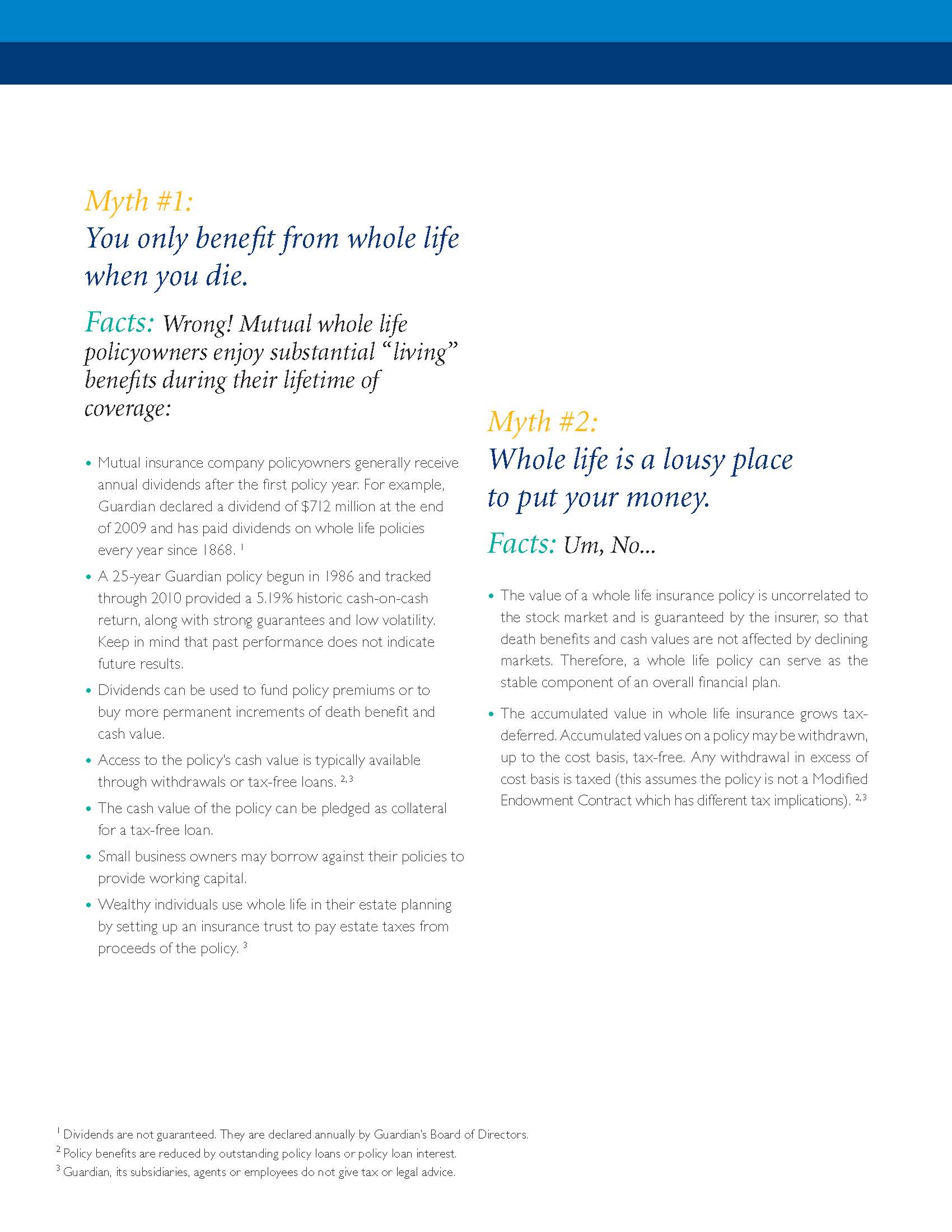
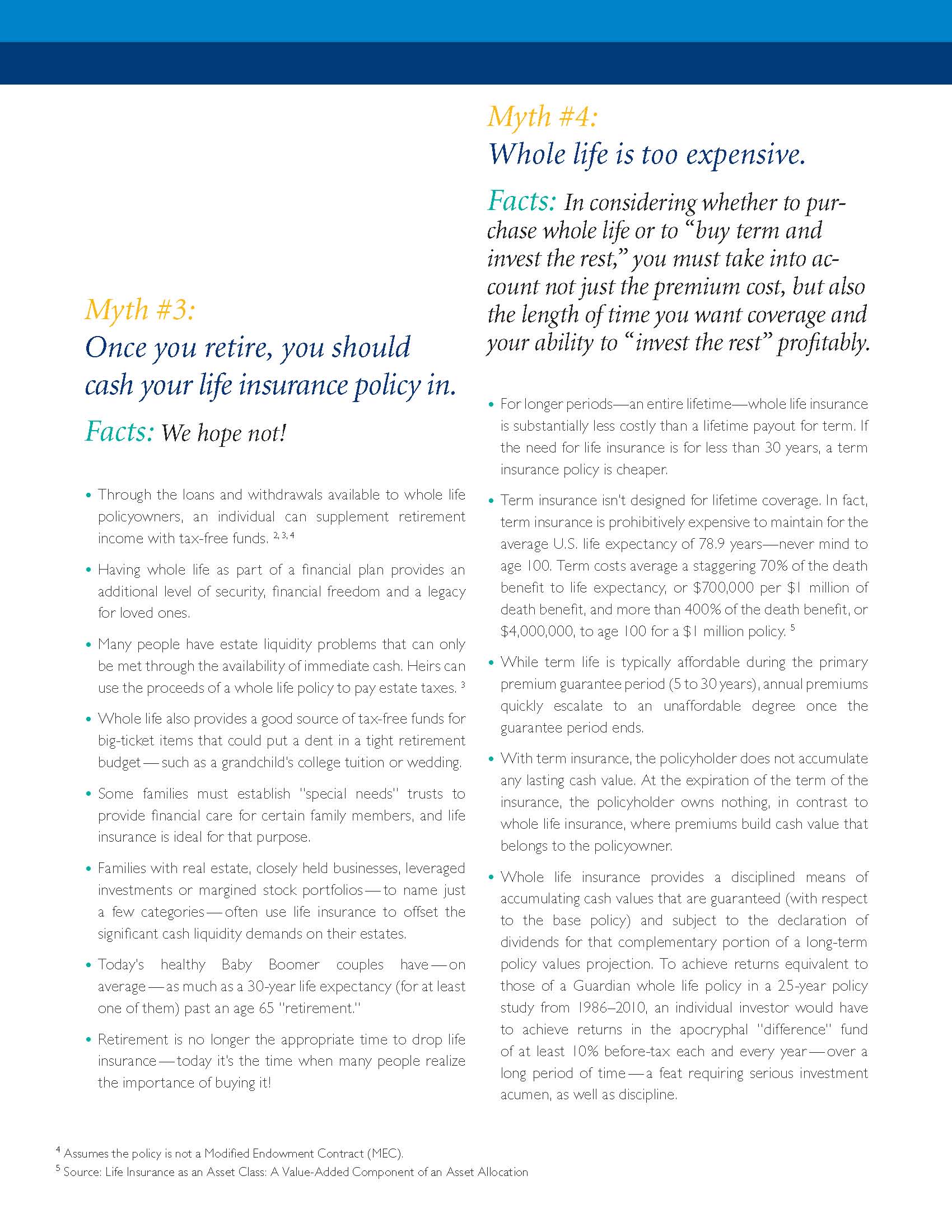
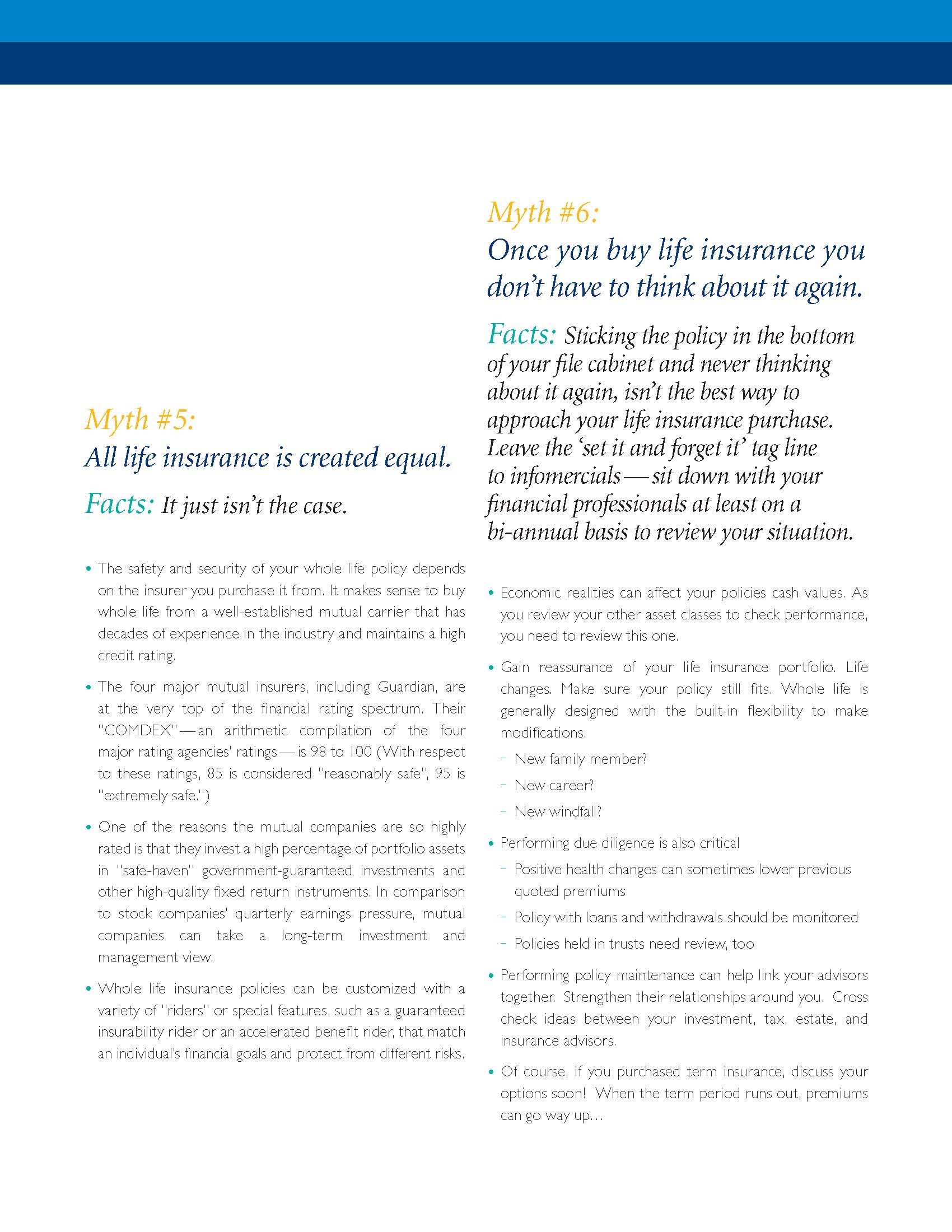
Debunking Common Life Insurance Myths
 Email Garrett Wheeler or contact him by phone at (808)216-4147 to set up some time to expand the conversation about life insurance. Also, you can request Guardian’s FREE research white paper, “Debunking the Myths…” Here’s to your continued success!

The Things We Do for Love
We go to great lengths for our loved ones. We work hard to provide them with a life filled with happiness, comfort and opportunity. In fact, there’s almost nothing we wouldn’t do for our loved one. However, there’s an economic plague in this country of people being under- or un-insured. According to research by LIMRA International, a worldwide association of insurance and financial services companies, the majority of adult Americans do not own an individual life insurance (LI) policy.
Some advisors will sit down and talk your ear off about life insurance in terms of numbers and percentages. At that point, they’ll whip out fancy illustration charts to explain to you why it’s an important financial instrument to own. Numbers aside, I believe there is really only one simple reason to own life insurance and that’s, L-O-V-E. That’s right, it’s love. The bottom line: You buy life insurance to provide financial protection for those you love (and, as the case may be, the business you have worked hard to create). What can say “I love you” better than a promise to provide for the ones you love, while you’re here (living benefits of investment-grade LI), or even after you’re gone.
Maggie Leyes, with the nonprofit LIFE Foundation, asks the critical question: “How long would it be before life would become a financial struggle for your family if you weren’t in the picture anymore?” That’s where life insurance comes in—it helps you plan for the unexpected and ensure the financial well being of your family if you were to die. Ensuring that you have the proper amounts of life insurance in place is right thing to do, and it doesn’t have to be a chore, either. Start with this easy online Life Insurance Needs Calculator.
September is Life Insurance Awareness Month, the perfect time to take stock of your life insurance needs. Don’t be another statistic of the un- or under-insured. Take the first step by checking out this video and/or the information about the different types of life insurance that are available to find out which may be right for you.
 SEA Financial Hawaii