
Category: Investments/Savings
The Wheeler Group Participates in First-ever Personal Finance Expo in Honolulu

Over this past weekend, we at The Wheeler Group LLC participated in the first-ever Personal Finance Expo here in Honolulu. The nonprofit Hawaii Council on Economic Education and the Hawaii Event Group hosted this well-received event. The two-day expo took place on Aug. 15 and 16 at the Neal S. Blaisdell Center and featured more than 30 seminars and a variety of exhibitions from both private companies and the government. The goal of the expo was to educate people of all ages about topics such as debt management, investments, retirement plans, employment and entrepreneurship and even the basics of starting a new business.
 In my estimation, Kristine Castagnaro, and her team at The Hawai`i Council on Economic Education exceeded event expectations and did a wonderful job for bringing together participants and exhibitors as resource providers. We were fortunate to meet numerous people interested in learning more about our programs designed to help them with retirement accumulation–saving tax-deferred, as well as distribution planning through tax-advantaged programs. As we shared with visitors to our booth, we believe that annuities and insurance are the essential foundational elements of a diversified portfolio, and we believe in safety through guarantees and asset allocation.
What’s Worse? Paying Too Much or Too Little?
 As English author and art critic, John Ruskin, said so eloquently,
“It’s unwise to pay too much, but it’s worse to pay too little…”
Ruskin went on to say, “When you pay too much, you lose a little money, that’s all. When you pay too little, you sometimes lose everything, because the thing you bought was incapable of doing the thing it was bought to do.
The common law of business balance prohibits paying a little and getting a lot—it can’t be done.” (Or as I recall my father stating, on more than one occasion, and as a matter of fact, “You get what you pay for in this world…” Simple, sage advice–the absolute very best kind!) Ruskin continued and summarized, “If you deal with the lowest bidder, it is well to add something for the risk you run and if you do that you will have enough to pay for something better.”
And finally, along that same line of thought, Ruskin was quoted as saying, “It is not how much one makes but to what purpose one spends.”
How Does Your Bank Rate?

Of the military-specific organizations that we represent at The Wheeler Group LLC, Trans World Assurance (TWA) was founded by Charles P. Woodbury, a decorated WWII fighter pilot, whose background was in finance. In an April 5, 2009 article that appeared in the Pensacola News Journal, Carlton Proctor (cproctor@pnj.com) asked the question, How does your bank rate?
The Less Taxing Roth IRA
“A Roth IRA is an Individual Retirement Account that provides tax-free growth. As a result, it’s the simplest – and potentially the most effective – sheltered account imaginable.” –Moneychimp.com
Considering the Roth IRA is a way to totally avoid paying taxes on your retirement savings, it’s puzzling why more of us don’t embrace it. Here’s some startling statistics from Fidelity: only 19% of working Americans hold Roth IRAs, even though 90% qualify for them. And according to the most recent numbers from the Federal Reserve Survey of Consumer Finances, only 4% of all IRA assets are held in Roth IRAs. Continue reading
Putting On Your Oxygen Mask First: A Child’s Education
Borrowing from the airplane analogy of, “Putting On Your Oxygen Mask First”, I’m applying it to saving for your child’s education. One of my clients recently asked me whether they should focus on financing their child’s education now and worry about their own retirement at a later time.
High Expenses Involved in Mutual Fund Investing
Every mutual fund has expenses and can have a negative effect on your returns. If you’re like me, and the rest of the stock market investors who have lost (on paper at least) vast sums due to the market’s downturn, you need to be invested in mutual, or better yet, index funds with low expense ratios. Check out the following pdf that we share with clientele.
Priority #1: Managing Yourself and Your Time
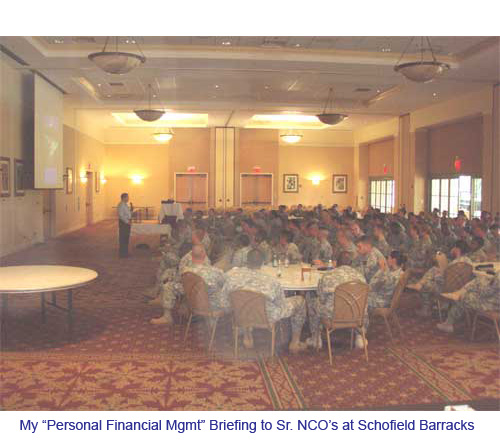
This month marks the seven-year point of my stint working with military personnel based here in Hawaii. I consider myself fortunate to play a small role in helping our fighting men and women of the U.S. Armed Forces achieve their financial goals.
By doing what I do, they are given the peace of mind and the assurance that they can provide for their families on a long-term basis. For me this is why I do the thing I do.
There are great parallels between what we have created at SuccessHawaii and what I do at The Wheeler Group LLC through our association with the military. Like SuccessHawaii, our goal is simple–“to help our clients reach theirs.”
Be Like the Babe!

From 1924 to 1930, Harry Heilmann worked in the off-baseball season as a licensed insurance agent. He was a star baseball player with the Detroit Tigers and was the Batting champion four times with them. As a result he became very good friends with Babe Ruth, and in fact sold one or more annuity policies to the Babe (and his girlfriend then wife Clara Mae Merritt Hodgson). The Babe had Heilmann come to New York and complete these annuity purchases in 1924 to 1930. the Babe and Mrs. Ruth subsequently started taking $1000 a month withdrawals from these accounts right after the Great Depression to maintain their lifestyle.
Purportedly there may have been more than one annuity contract and more than one annuity (life insurance) company used. These accounts were started with approx. $35,000; and $50,000. each beginning as early as 1924 and the last one in early 1929.
In retrospect, the “Babe” must have seemed like a financial mastermind back when it was all crashing around. His decision to transfer money from more “risky” investments into safer ones was sheer genius.
Emerging Equity Markets are Not the Emerging Economy
With regard to international, *emerging markets I believe and I’m betting real dollars (Vanguard Emerging Markets Stock Index Fund Investor Shares) that the current happenings in the equity markets does not reflect the true economy. We may have overshot on the high side, but while the fact remains that international, emerging markets are extremely volatile, the sector represents true global growth in the future. My indicator: Cash flow. Companies exist on earnings and profits. Look to their balance sheets and numbers don’t lie (well, let me retract that notion; let’s agree, it’s dependent on who is reporting the numbers…Enron, Lehman, etc.)
Time is Money. Why Lose Either One?
When does -30 + 43 = 0?
When it involves placing your hard earned retirement dollars directly into the stock market. If you LOST 30% this year, it would take a 43% GAIN next year just to get you back to where you started!
Recent headlines have been unnerving, to put it mildly. High-profile banks (Wachovia), brokerages (Lehman), and insurers (AIG) have been acquired, gone bankrupt or sought government loans. On September 29, when the U.S. Congress first rejected the Emergency Economic Stabilization Act of 2008, the U.S. stock market lost more than 8% of its value, its biggest one-day decline in more than two decades.
It’s no secret that playing the market has its risks, and losing money is only half the story. Have you ever thought about the time it would take for you to make up those losses? Here’s how long it would take to rebuild your nest egg after a loss in the market. (See chart below.)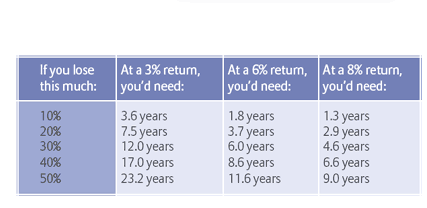
Safe havens have been scarce. With the exception of U.S. Treasury securities–which one of our programs, the Flexible Dollar Builder is primarily invested into–just about all market segments have struggled. Also, as a hedge against downside risk, a fixed indexed annuity from Allianz can further help protect your portfolio. If the market drops in a year, your annuity’s value will remain constant. Later, if the market return is positive, your annuity’s value will increase-even if the market doesn’t make up its previous losses.

For example, let’s consider a modest, conservative example. A fixed index annuity with annual reset from Allianz with $100,000 in initial premium. (1) Let’s assume that the first year the market had a 32% loss. Had you invested your premium in the market, your portfolio would then be worth just $68,000. But with your fixed index annuity, you are protected from decreases in the market, and your annuity’s value remains at $100,000. (2) Now assume that in the second year, the market “bounced back” with a full 12% return. If you were invested in the market, your market value would still be much less than your original investment.
But in an Allianz fixed index annuity with a 7.5% cap, your original $100,000 annuity value would grow to $107,500 – worth almost $26,000 more than your money would be in the market. This hypothetical example is provided for illustrative purpose only. With the potential for downside risk protection, your annuity’s value increases or stays the same and never has to regain costly losses. Just imagine the potential for growth without the threat of decreases. Again, diversification.
Although an individual stock like Lehman Brothers can lose all its value, it’s highly unlikely that the value of all publicly traded U.S. businesses would go to zero. But as it has recently, the stock market can fluctuate dramatically. This market risk is the trade-off for the stock market’s potential to produce higher returns over time than those produced by less volatile assets.
As they have in crises past—the junk-bond meltdown in the early 1990s, the collapse of the tech-stock bubble in 2000—the time-tested principles of diversification and balance, fortified by a long-term perspective (you need to have time on your side), will most likely prove a productive response to the market’s turmoil.
 SEA Financial Hawaii