
Category: Annuities
Time is Money. Why Lose Either One?
When does -30 + 43 = 0?
When it involves placing your hard earned retirement dollars directly into the stock market. If you LOST 30% this year, it would take a 43% GAIN next year just to get you back to where you started!
Recent headlines have been unnerving, to put it mildly. High-profile banks (Wachovia), brokerages (Lehman), and insurers (AIG) have been acquired, gone bankrupt or sought government loans. On September 29, when the U.S. Congress first rejected the Emergency Economic Stabilization Act of 2008, the U.S. stock market lost more than 8% of its value, its biggest one-day decline in more than two decades.
It’s no secret that playing the market has its risks, and losing money is only half the story. Have you ever thought about the time it would take for you to make up those losses? Here’s how long it would take to rebuild your nest egg after a loss in the market. (See chart below.)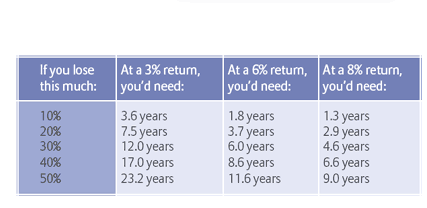
Safe havens have been scarce. With the exception of U.S. Treasury securities–which one of our programs, the Flexible Dollar Builder is primarily invested into–just about all market segments have struggled. Also, as a hedge against downside risk, a fixed indexed annuity from Allianz can further help protect your portfolio. If the market drops in a year, your annuity’s value will remain constant. Later, if the market return is positive, your annuity’s value will increase-even if the market doesn’t make up its previous losses.

For example, let’s consider a modest, conservative example. A fixed index annuity with annual reset from Allianz with $100,000 in initial premium. (1) Let’s assume that the first year the market had a 32% loss. Had you invested your premium in the market, your portfolio would then be worth just $68,000. But with your fixed index annuity, you are protected from decreases in the market, and your annuity’s value remains at $100,000. (2) Now assume that in the second year, the market “bounced back” with a full 12% return. If you were invested in the market, your market value would still be much less than your original investment.
But in an Allianz fixed index annuity with a 7.5% cap, your original $100,000 annuity value would grow to $107,500 – worth almost $26,000 more than your money would be in the market. This hypothetical example is provided for illustrative purpose only. With the potential for downside risk protection, your annuity’s value increases or stays the same and never has to regain costly losses. Just imagine the potential for growth without the threat of decreases. Again, diversification.
Although an individual stock like Lehman Brothers can lose all its value, it’s highly unlikely that the value of all publicly traded U.S. businesses would go to zero. But as it has recently, the stock market can fluctuate dramatically. This market risk is the trade-off for the stock market’s potential to produce higher returns over time than those produced by less volatile assets.
As they have in crises past—the junk-bond meltdown in the early 1990s, the collapse of the tech-stock bubble in 2000—the time-tested principles of diversification and balance, fortified by a long-term perspective (you need to have time on your side), will most likely prove a productive response to the market’s turmoil.
Priority #1: Managing Yourself and Your Time
This month marks the seven-year point of my stint working with military personnel based here in Hawaii. I consider myself fortunate to play a small role in helping our fighting men and women of the U.S. Armed Forces achieve their financial goals. By doing what I do, they are given the peace of mind and the assurance that they can provide for their families on a long-term basis. For me this is why I do the thing I do.
There are great parallels between what we have created at SuccessHawaii and what I do at The Wheeler Group LLC through our association with the military. Like SuccessHawaii, our goal is simple–to help our clients reach theirs.
When meeting with prospective customers, I share with them the concept and idea that my mom, Dr. Linda Andrade Wheeler, passed on to me: If you don’t have a dream, you can’t make a dream come true. It all begins with goals. This is the beginning point. Without having a clear idea of what they want in life, the point of meeting with me is lost. They, like all of us, need a crystal clear vision of where they want to be financially in the future. Once we nail that down, we can move forward breaking their financial goals into manageable, realistic steps that will get them where they want to be.
“If you don’t have a dream, you can’t make a dream come true.”
In the past, Dr. Wheeler has given of herself and has conducted free seminars for the troops here in Hawaii. The emphasis of these classes is not simply money management, but rather a much more comprehensive approach to managing one’s life. It all starts with the notion of self-management. The core element in all of this is the empowering concept of developing a personal philosophy that makes you the owner of your own destiny, and not the victim of your circumstances.
In order to make this work, you need to develop a specific and practical plan of action for personal development. Your personal belief about yourself and what you deserve in life greatly impacts the actions you take in designing your destiny. In this day and age, it is all about balancing everything: mentally, emotionally, intellectually, physically and financially. In the Hawaiian language, there is a term that sums this up quite nicely. In essence the term, “Hookaulike”, means to bring into balance all the things to make you feel in harmony with the universe.
The second element she addresses in the seminar is the component of managing your time; ever critical in this fast-paced world we live in. A primary focus in this approach to time management is to plan your work; and work your plan. As she succinctly puts it,
“Goals without action is daydreaming; action without goals is spinning your wheels; but action with goals will get results.”
I don’t know about you, but I’ve daydreamed and spinned my wheels many times. I appreciate the simple and constant reminder that we all need to put goals on paper, and then figure out the best way to make them come true.
So what does it take to accomplish your goals and meet with the success you’re looking for?
Well, the next time I conduct seminars–for the 500th Military Intelligence division at Schofield Barracks (through Sgt. Major Marty Glenn) on October 17th, and in November for MSgt. Noel DeMello and his crew at the Hawaii Air National Guard–I will share that it takes desire, discipline and dedication. Like anything else, you don’t get anything for nothing. When it comes to wealth accumulation, you never get anywhere if you don’t have the savings habit. ‘Pay yourself first and what you don’t see, you won’t miss,’ is the old cliché, but altogether correct. But when you give something, you’re more likely to get something back. You’ve got to give to get what you desire. Like everything else in this world, it begins with you.
Saving Money $2 At a Time
I still remember receiving $2 bills for my birthday every year. As if a family tradition, my grandparents (who lived in the Sierra Nevada mountains of California) sent them to me in Hawaii every year without fail. There was never a surprise, just a $2 bill in the letter. Without missing the message, my parents always made us call them to express our appreciation.
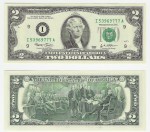

At the time, I used to think they were a bit tight. Later I would learn that when they passed on, they had amassed over $125,000 (in the 1980’s) in bank savings! I was proud of them and understood why they did what they did.
They knew something about saving money. Maybe there hope was that I would choose to save the $2 bills as keepsakes—I still have them 30 years later—and not spend them. (Later I would learn the importance of, “compound interest”.) According to the United States Department of the Treasury, it seems to be what most people do with them.
In spite of its relatively low value among the denominations of U.S. currency, the two-dollar bill is one of the most rarely seen in circulation and actual use. They are almost never given as change for commercial transactions, and thus consumers rarely have them on hand. After 13 years in business as a day-to-day retailer at Successories of Hawaii, I can’t remember accepting a $2 bill as form of customer payment. Production of the note is quite low; approximately 1% of all notes currently produced are $2 bills.
The $2 bill has not been removed from circulation and is still a circulating denomination of United States paper currency. The Federal Reserve System does not, however, request the printing of that denomination as often as the others. As of April 30, 2007 there were $1,549,052,714 worth of $2 bills in circulation worldwide.
In one of her catch phrases, gold-hued financial planning guru, Suze Orman, put it in perspective well, “People first, then money, then things”. My grandmother had her own way of summing the same up. In every letter she wrote, she signed-off, “Remember you are loved”. I agree that we all need to know that we are loved. But at eleven years old, I assumed that. I just wanted a $20, not a $2 bill. Thanks, grandma.
United States
Department of the Treasury
http://www.ustreas.gov/education/faq/currency/denominations.shtml
 SEA Financial Hawaii